

Ancient teeth provide new insight into the lives of the world’s first farming villagers in Neolithic Syria
Researchers, led by the universities of Durham and Liverpool, UK, analysed the chemical signatures in teeth from 71 people, spanning the entire Neolithic period of southwest Asia, from 11,600 to 7,500 years ago.
The teeth were found at five archaeological sites in what is now modern Syria.


By analysing the strontium and oxygen isotopes in the tooth enamel, the researchers were able to establish if the individuals grew up locally or whether they moved from a different area – reconstructing previously invisible patterns of mobility.
This tooth analysis, combined with skeletal evidence and funerary practices, revealed that once permanent villages were firmly established, most people stayed local and strengthened ties to particular communities.
Interestingly, towards the end of the Neolithic it appears that women were more likely than men to move between communities.
This suggests patrilocal traditions, in which women relocated to form marriages in new communities, whereas men remained in their home villages.
This movement cycle may have evolved to avoid inbreeding within communities.
The study also found that local and non-local individuals were often buried together and received the same, sometimes exceptional, funerary treatments.
The research is published in the journal Nature Scientific Reports.
Senior author, Dr Eva Fernandez-Dominguez of Durham University’s Department of Archaeology, said: “This research allows us to see, for the very first time in this region, how mobility and social connections shaped the earliest farming societies.
“We found that villagers largely stayed local, yet they welcomed newcomers who appeared to be fully integrated into social and funerary life.
“The evidence of women moving between villages also points to complex social dynamics in the world’s first permanent settlements.”
First author of the study, Dr Jo-Hannah Plug, currently of the University of Oxford, said: “The Late Neolithic period in this region is archaeologically known for the development of new cross-regional networks, innovation, and the movement of material culture, animals, and ideas.
“Our research, for the first time, shows direct evidence for the movement of people during this period too.
“Our observation that women in particular were mobile, illustrates their – likely central – role in the processes of innovation and the establishing of cross-regional networks of the Neolithic period.
“Our results suggest that the reproductive networks of this period extended beyond the direct neighbouring communities, and that marriage partners were sought potentially quite far away.”
The researchers found that at some sites, individuals who originated elsewhere appeared fully integrated into village life, suggesting early farming communities were inclusive and open to newcomers.
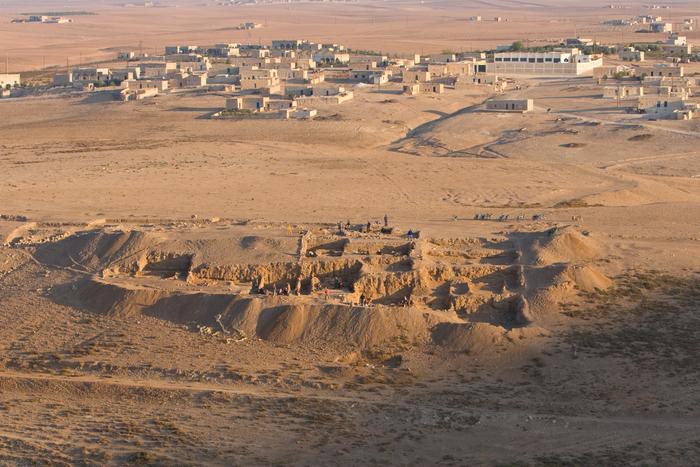
One striking example came from one of the sites, Tell Halula, where multiple layers of human remains were preserved within house floors.


Analysis revealed that the individuals buried together in the same house included both locals and non-locals, all treated with the same funerary practices.
Further evidence across the samples showed that local and non-local people were buried in close proximity in the same cemeteries and spaces, with the same elaborate burial assemblages and with similar post-mortem manipulations such as being buried in a seated position.
This indicates that mobility did not preclude social inclusion, and that villagers in the Neolithic period were open to assimilating newcomers fully into community life and afforded them the same distinct treatment in death.
The study demonstrates how scientific techniques, such as isotope analysis, can transform our understanding of human social life from thousands of years ago.
It also fills a major knowledge gap in the Northern Levant, a key corridor for the spread of agriculture and settled human societies.
The research was funded by The Leverhulme Trust.
Press release from Durham University.
Earliest Neolithic communities were inclusive and open to newcomers
An international study with the involvement of the UAB, published in Nature Scientific Reports, reveals new findings based on the teeth found at five archaeological sites in Syria. These findings give new insights into how the world’s first farming villagers formed communities, moved across the land, and responded to outsiders. The research reconstructs mobility patterns that had never been observed before.


An international team of researchers, including the involvement of the Research Group in Archaeology of the Mediterranean and the Near East (GRAMPO) of the Department of Prehistory at the UAB, analysed the chemical signatures of the teeth of 71 people found in five archaeological sites in the Euphrates Valley, present-day Syria. The remains cover the entire Neolithic period between 11,600 and 7,500 years ago, the period in which the first settlements and cities were created.
By analysing the strontium and oxygen isotopes of tooth enamel, researchers were able to establish whether individuals were locals or had moved there from a different area, reconstructing previously invisible patterns of mobility.
Analysis of the teeth, combined with skeletal remains found at the sites and evidence of funerary practices, reveal that once villages were firmly established, the majority of the population stayed and ties with particular communities were strengthened.
Women were more likely to move
Interestingly, the research demonstrates that towards the end of the Neolithic it appears that women were more likely than men to move between communities. This suggests patrilocal traditions, in which women relocated to form marriages in new communities, whereas men remained in their home villages.
This movement cycle may have evolved to avoid inbreeding within communities.
Inclusive communities
Researchers found that in most cases individuals born elsewhere appeared fully integrated into village life, suggesting early farming communities were inclusive and open to newcomers. Evidence of that was that local and non-local people were buried in close proximity in the same cemeteries and spaces, with the same elaborate burial assemblages and with similar post-mortem manipulations, such as being buried in a seated position.
One striking example of this came from one of the sites, Tell Halula, where multiple layers of human remains were preserved within house floors. The analysis revealed that the individuals buried together in the same house included both locals and non-locals, all treated with the same funerary practices.
This indicates that mobility did not preclude social inclusion, and that villagers in the Neolithic period were open to assimilating newcomers fully into community life and that newcomers received the same distinct treatment in death.
“The study is important for the interdisciplinary methodology used, on the one hand a broad development of isotope analysis (strontium and oxygen) and on the other hand the study of the archaeological and historical context of the area”, explains Anna Bach, lecturer in the UAB Department of Prehistory. The research team of the Universitat Autònoma de Barcelona worked for more than 20 years at the Tell Halula site, located in the Euphrates Valley near Aleppo. “The digs began in 1991 and were suspended in 2011 due to the war, and unfortunately we have not been able to continue our work there, and are now working in Iraqi Kurdistan”, says Miquel Molist, lecturer in the same department and coordinator of the UAB’s GRAMPO research group. Despite the hardships, the studies on the Neolithic in the Euphrates Valley continue “with the analysis and study of the archaeological samples that were obtained and temporarily deposited at the UAB, both by researchers from the university and, above all, by the broad international collaboration, an example of which is the work that has given rise to this publication”.
The research recently published in Nature Scientific Reports is the result of a project led by Eva Fernández, lecturer at Durham University, UK, and a team of several European universities and research groups, including the Research Group in Archaeology of the Mediterranean and the Near East (2012 SGR 00744) of the UAB Department of Prehistory.
Bibliographic information:
Plug, JH., Blevins, K.E., Abbès, F. et al., Strontium and oxygen isotope analysis reveals changing connections to place and group membership in the world’s earliest village societies, Sci Rep 15, 34598 (2025), DOI: https://doi.org/10.1038/s41598-025-18134-3
Press release from the Autonomous University of Barcelona